Yoga stool
Summary
A yoga stool is a short stool meant to help a person sit comfortably in the vajrasana position. It enables anyone to sit in this position and for a long time. In this page there is information about building a stool and also about the benefits of using one.
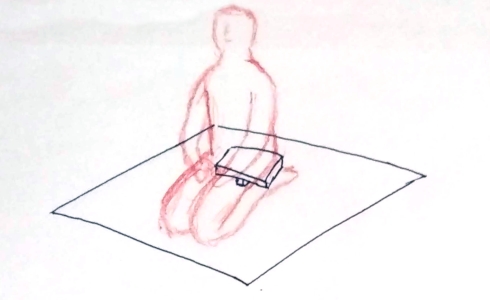
Building the stool
The stool has two main characteristics:
- it has a single leg that fits in between the ankles of the person when sitted (or two legs distanced so that both ankles can rest in between them)
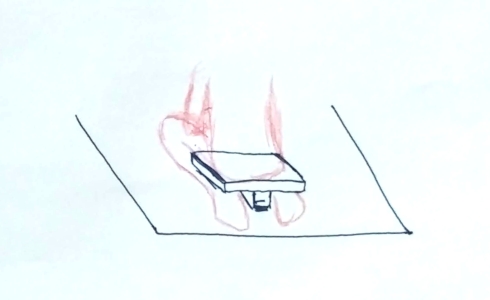
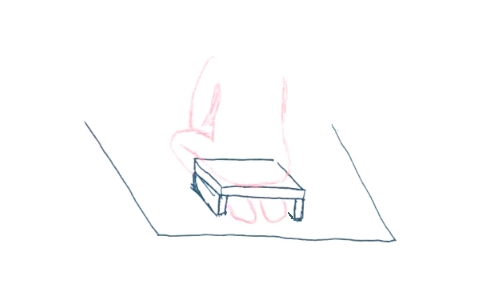
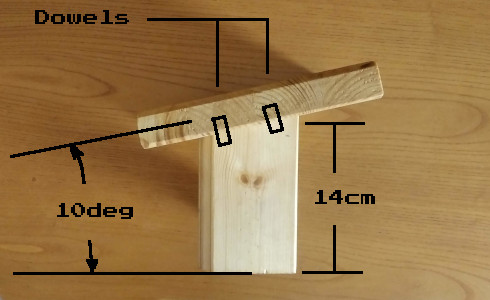
- the sit is tilted and parallel to the person's thighs when seated
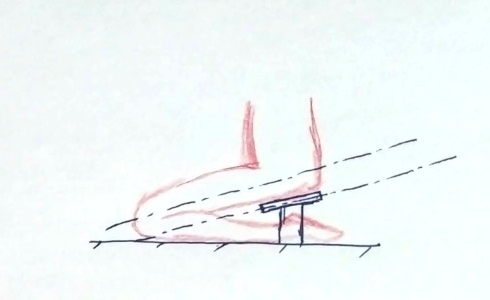
The height of the stool's leg (or legs) is important since it will determine how deep someone can sit on it and, in turn, that determines their thighs' angle and the tilt that should be given to the sit.
This small wooden yoga stool was made by joining two pieces of wood using wood-glue and a couple of dowels.
Vajrasana
Vajrasana is a position that helps overcome the most common body/muscle stiffness one has to fight against when trying to sit upright. Finding comfort in sitting upright is a great feeling and can help in meditation. Other activities can also be done in this position such as reading. Vajrasana is also said to have digestion and nutrition aiding abilities and is suggested to be practiced on a full stomach after a meal.
Using a stool
Sitting in the vajrasana position without a stool means that the body's weight rests entirely on one's feet. It can become painful after a while. This can be countered by using a yoga stool. Also, not using a stool means that the knees are bent to their maximum angle. While usually this is not a problem, people with sensitive knees can use a stool to relief from this knee stretch in the vajrasana position.
Sitting upright
Sitting upright by itself is obviously not a hard task - anyone can do it. What is tricky is finding balance in this position. That means getting to a point where one does not have to use much effort to retain the position.
When asked to sit upright, most people get tired after a while and that is because they are actively trying to retain the position using considerable amounts of muscle effort. A big part of the reason this happens is often a tilted pelvis. Being the base of the entire core of the human body, it is apparent that its positioning plays a crucial role in finding balance when sitting upright.
There are two main groups of muscles that apply tension to the pelvis and can cause it to tilt. The muscles on the front of the thighs tend to tilt the pelvis forward while the muscles on the back of the thighs tend to tilt the pelvis backward.
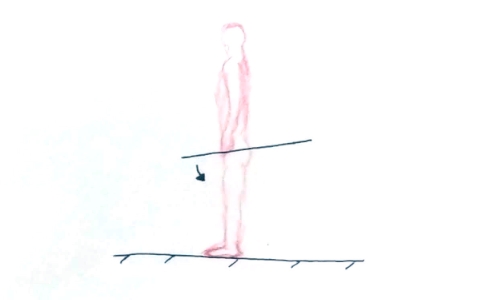
In positions such as tadasana tension applied by the muscles on the front of the thighs is usually dominant and the pelvis tends to tilt forward. That happens because the angle between the front of the thigh and the pelvis reaches its maximum, thus the front group of muscles is stretched.
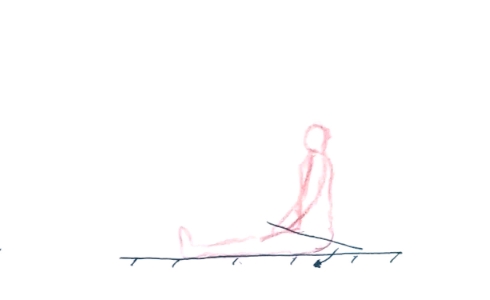
In positions such as dandasana this angle is decreased and instead the group of muscles on the back of the thigh are stretched. As a result, the tension applied by the muscles on the back of the thigh is usually dominant and the pelvis tends to tilt backward.
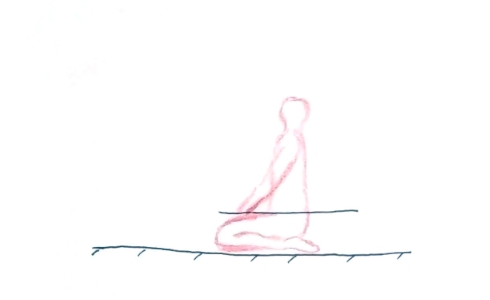
In vajrasana the group of muscles on the front of the thigh remains loose and the bent knees help alleviate the tension from the muscles on the back of the thigh. The tension received by the pelvis is minimized and this is why it is so much easier to sit upright in this position.
Stool helpful side effect
When sitting on a yoga stool, the tilted sit interacts with the pelvis in the same way a tilted surface interacts with a sphere. There are two forces that act on the pelvis from the stool:
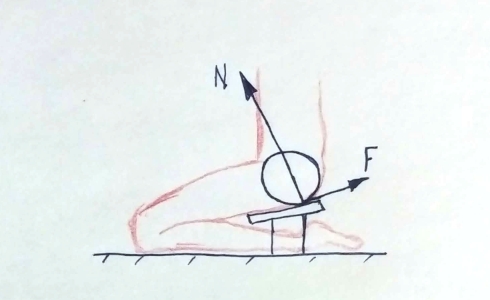
- the reaction from the sit perpendicular to the sit's surface (N)
- a friction tangent to the sit's surface and towards the back (F)
This friction generates a torque on the pelvis and can be useful in counteracting the remaining tension applied to the pelvis by the muscles on the back of the thigh.