PX625 vintage battery adapter
Summary
This is an adapter that uses modern battery cells and emulates the behavior of discontinued old batteries. Some vintage products require batteries that are no longer available in the market and this adapter is the solution. In this page there is information about its design and use as well as files for creating one.
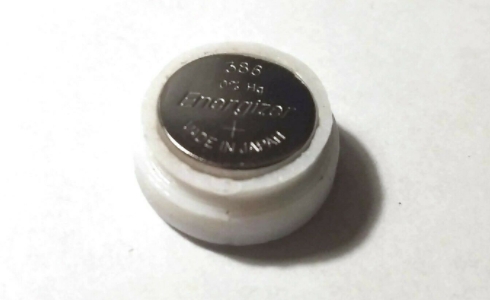
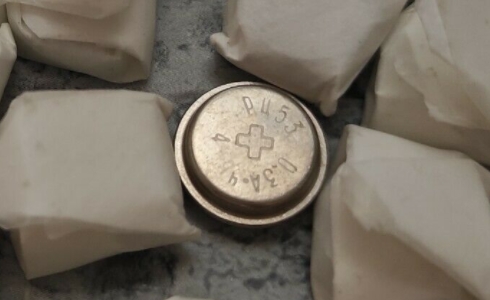
The old batteries
This adapter replaces a series of button cells that were discontinued because their chemistry was harmful to the environment. Manufacturing of the PX625 and all mercury batteries is today banned in most countries. Nevertheless, at the time of writing this page (12/2021), mercury batteries are still available for purchase on e-Bay by Russian sellers.
These batteries were chosen by manufacturers in the past because they offer very stable voltage throughout their entire discharge cycle. This enabled the manufacturers to avoid installing voltage regulators in their cameras and products thus cutting a lot of costs from production. Out of all the vintage cameras today, only a couple models are equipped with voltage regulators and can function correctly with modern batteries (more information here).
Modern batteries
Today, there are two kinds of batteries that are mostly used to replace old mercury cells:
-
Zinc-air batteries are mostly intended for use with hearing aids. Much like old mercury cells, these cells are able to produce a stable output voltage. They have good capacity (2-4 months of use) but need ventilation in order to work. These batteries produce voltage through a chemical reaction that requires oxygen. Therefore, when using these cells the battery compartment must have access to fresh air. In order to use a zinc-air battery, it is important to have good ventilation in the battery compartment and, also, some short of adapter might be needed because they are typically smaller in size than the old mercury batteries.
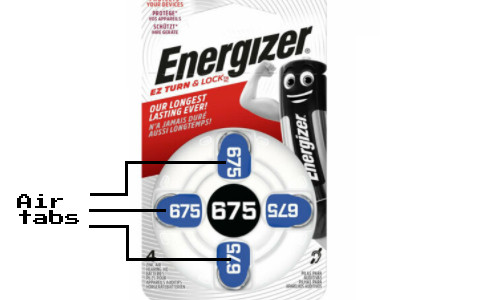
These cells have tabs on them for blocking the oxygen and staying inactive. In order to use one, its tab must be removed.
-
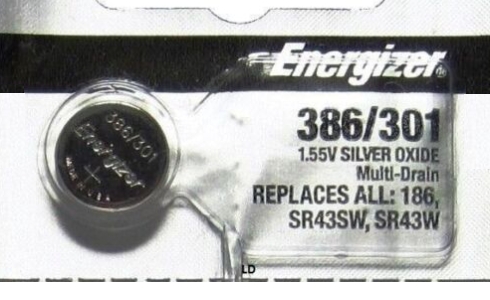
Silver oxide batteries are mostly marketed for use with watches. They have a stable voltage output and lower capacity than the zinc-air batteries but they do not require air to work since all the reactants are enclosed within the cell. Using silver oxide batteries requires a way to regulate their higher voltage and it also requires some short of adapter due to their smaller size.
Schematic
Silver oxide battery give off a 1.55V potential. Most vintage cameras require around 1.35V to operate correctly. Therefore, 0.2V must be dropped across the diode.
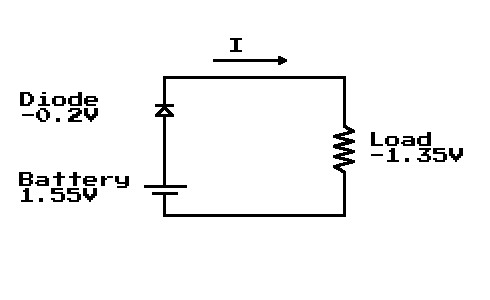
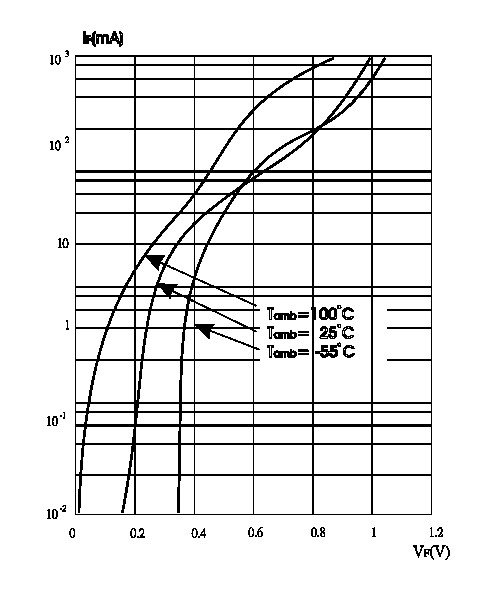
This diode must be carefully selected so that it drops as much voltage as needed. The selection becomes a bit complicated because the diode's forward voltage is a function of the current drawn through it. Ideally, the current draw of each application should be measured before selecting the diode. The diode for this adaptor was chosen by assuming most old light meters draw between 0.5mA and 1uA of current. After going through datasheets of various diodes, the BAT47 and BAT43 schottky diodes were chosen.
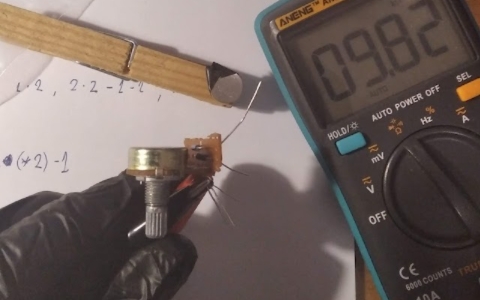
After purchasing the diodes, their forward voltage was tested. A new 1.55V 386 silver-oxide battery was used for the test. The battery was discharged slightly through a resistor prior to using it in order to skip the higher voltage region at the beginning of its lifespan. A potentiometer was used as the load and the schottky diodes were connected in series with the load and the battery. The resistance of the load was altered until forward voltages of 0.19, 0.2 and 0.21 Volts were measured on the diodes. The current draw was then measured for each forward voltage on the two diodes.
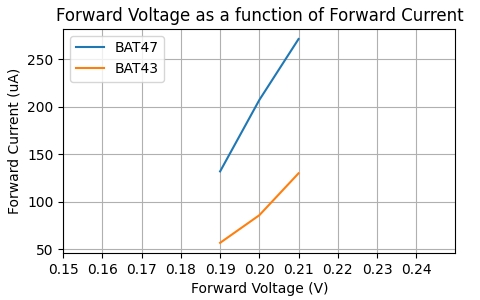
Nevertheless, the BAT43 diode is a safe bet for most applications and it is the diode used with other such adaptors.
Circuit
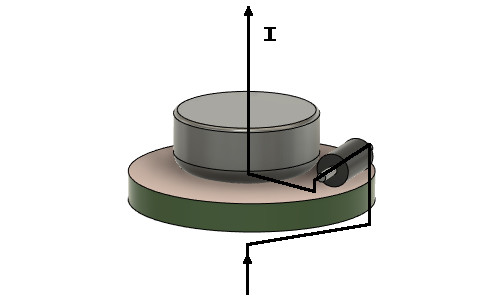
In order to place the diode in series with the battery in the adaptor, a piece of double sided copper clad board is used. The diode connects the two sides of the board and the battery sits on top of it. The direction of the current and the layout of the circuit becomes clearer in the next image.
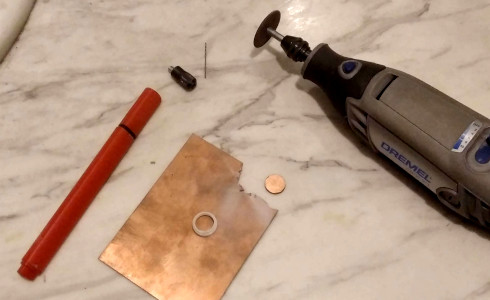
The copper clad board and thin steel sheet used were cut with a rotary tool.
Casing
Casings for both the 386 and the smaller 392 cells were designed. The casing of the 392 cell also requires a piece of 1mm thick conductive material to fill in because the cell is too short in its own.
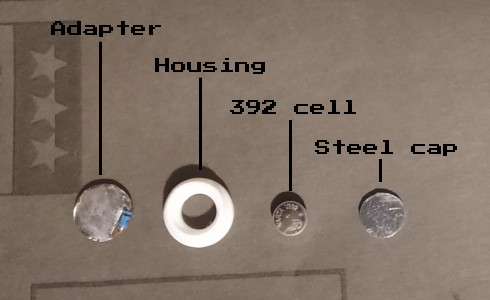
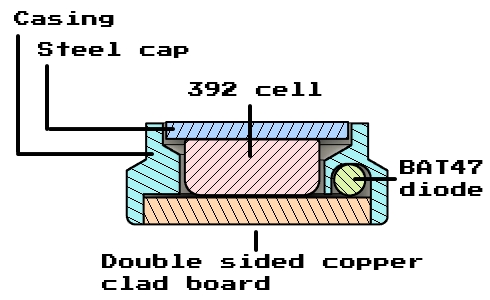
The 386 battery is much thicker so the diode was positioned inside the copper clad board and the board was trimmed a bit around that point. The area under the battery was filled in with some solder.
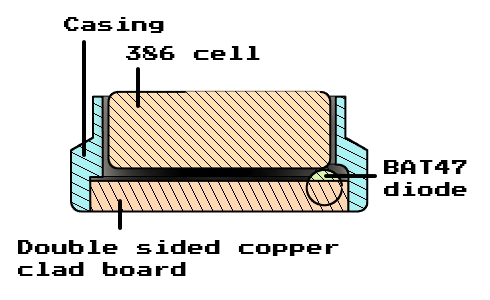
The above adaptors were proven to be slightly thicker than needed for some application so, a third, thinner adaptor was designed for the 386 cell.
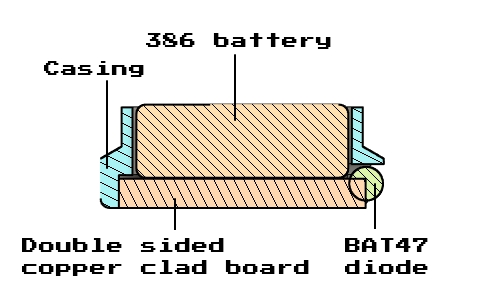
To make the adapter thinner the diode was pushed to the side of the casing and is now visible from the outside. This created the extra space needed to keep the battery tangent to the copper clad board.
The casings for the adaptors are printable without supports by orienting them thin side down. The STL files for both adaptors can be downloaded here.
Some battery compartments require electrical contact with the battery on its side. This adapter is plastic on its side and this will be a problem in such an application.
User manual
A short user manual for the adaptor is available here.
Licensing
This project is licensed under the Creative Commons BY-NC-SA 4.0.