Piezoelectric preamp
Summary
This is a preamplifier for a piezoelectric contact microphone. The piezoelectric element can pick sound when in contact with any acoustic instrument. The preamplifier then amplifies the element's signal so that it can be read by any standard guitar amplifier or console input. In this page there is information about building this preamplifier and how it sounds.
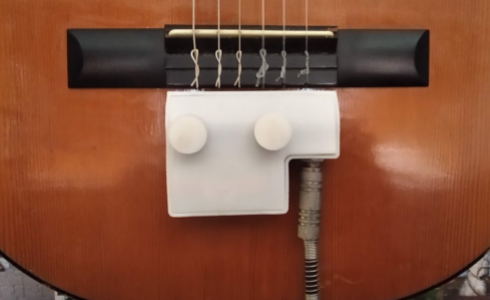
How it sounds
It should be noted though that the sound of a contact microphone is very sensitive to the location on the instrument that it will be attached to. On guitars the element is usually attached near the bridge or, if the installation of the element is not external, right under the bridge of the instrument. Nevertheless, some interesting timbres could be achieved by experimenting with the contact microphone positioning.
The piezoelectric element outputs a somewhat steel sound. In this setup, the element is positioned right under the casing of the preamplifier, near the bridge of the guitar. There are two knobs on the unit - the top one is for volume and the one near the jack is a tone knob.
The piezoelectric pickup can help bring out percussive sounds such as taps on the body or strings of the guitar:
Schematic
The preamplifier is based on a Texas Instruments LM386 audio amplifier IC. This IC features a bass-boost feature that was used to implement the tone knob. A gain of 20 to 200 can be set with external components on this IC. For this project a gain of approximately 60 was chosen as it yielded a signal of 2 volts peak to peak. As for the power, this IC works for a wide range of supply voltages: 4V - 12V. A 9V battery was chosen to supply the preamp.
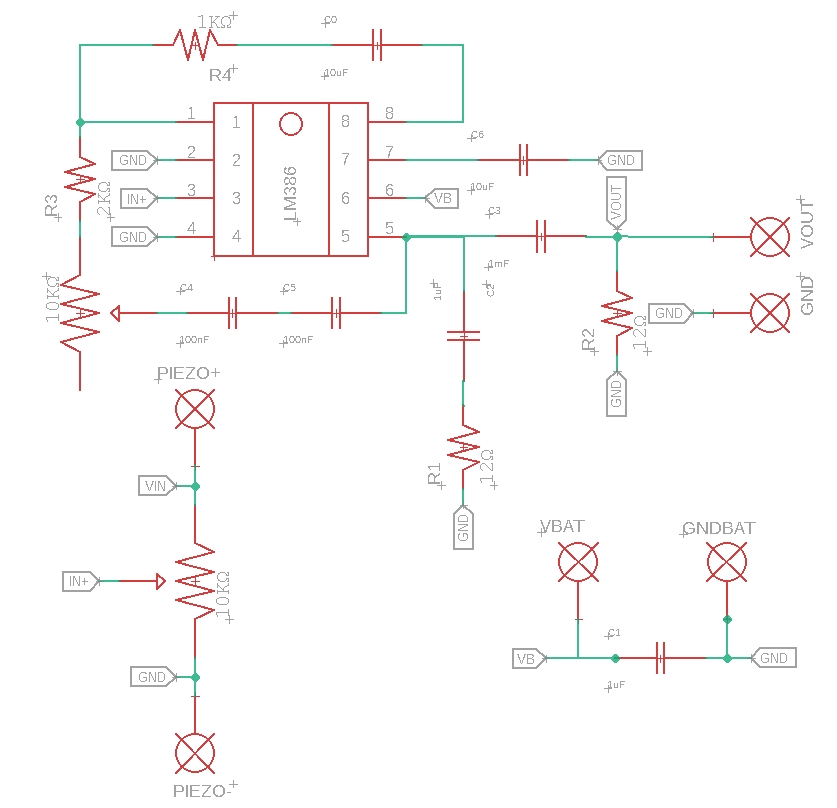
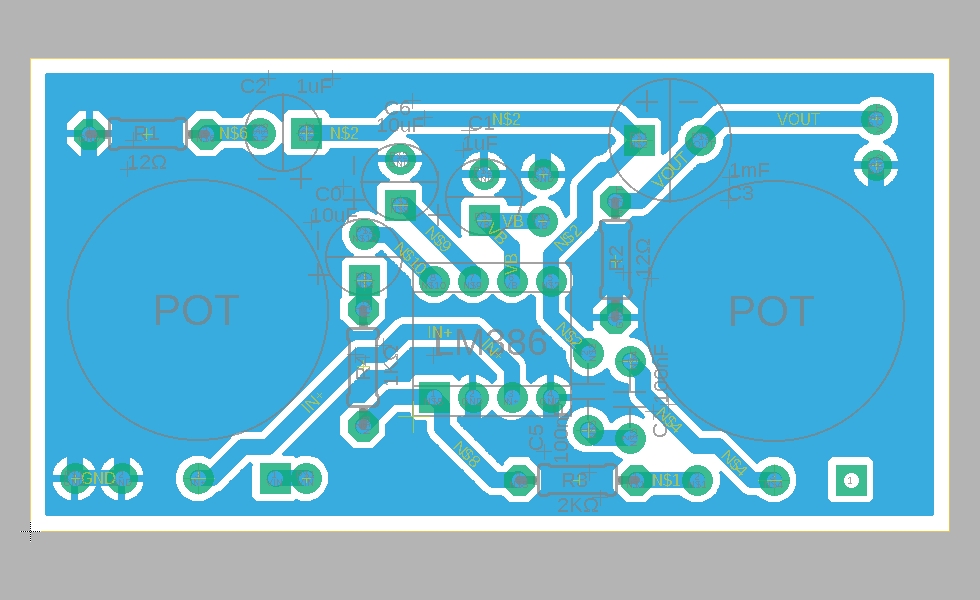
The PCB was designed in EAGLE. The gerber and drill files are available for download here.
LM386
There are some examples in the chip's datasheet that were used as reference to design the board.
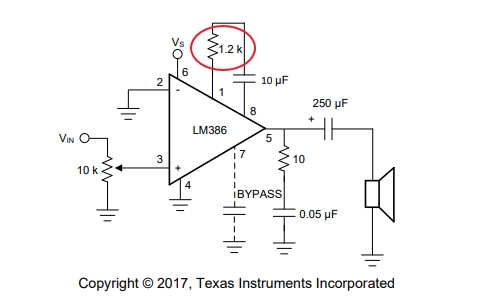
The resistor circled in the above image is responsible for tuning the gain of the amplifier. An infinite value corresponds to a gain of 20 while a short to a gain of 200. A resistor of 1.2KΩ corresponds to a gain of 50. For this design a resistor of 1KΩ was chosen through experimentation.
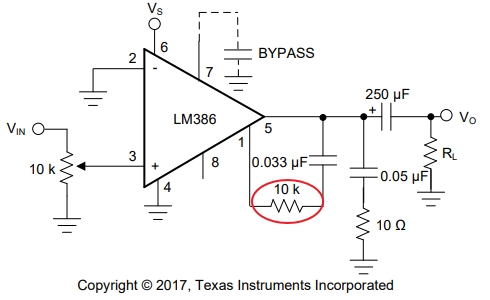
The bass boost feature was used to implement a tone knob. The resistor circled in the above image is responsible for tuning the frequency response of the amplifier. When there is a BYPASS capacitor the bass boost resistor can be as small as 2KΩ and yields a maximum bass amplification. For this reason a 2KΩ resistor is used in series with a 10KΩ potentiometer for tinkering with the frequency response of the amplifier. The greater value this resistor has, the more flat the frequency response of the amplifier gets.
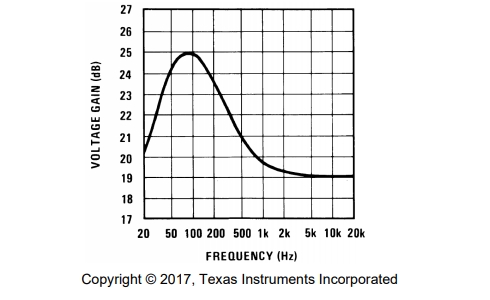
The datasheet for the LM386 amplifier IC is available here.
Board
The circuit board was designed in EAGLE and was machined out of one sided copper clad board. A 3D printer converted to a milling cutter was used for this purpose(available as a project here). The next video is a time lapse of the process at x10 speed:
This video skips two jobs of the process. The 1mm holes are pre-drilled with the V-bit to make it easier for the thin 1mm drill to grip. Also the traces are engraved twice because it helps get rid of copper filings that sometimes cause shorts.
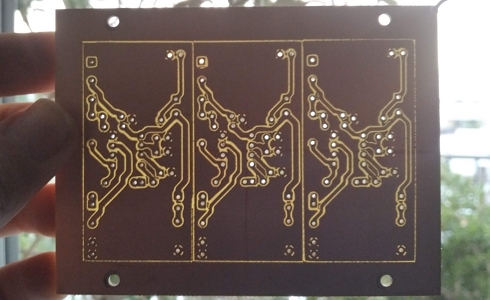
Component placement
The components were placed as the silk screen suggests except from the capacitors. The capacitors were tilted to save space and make the housing smaller. The positioning of the capacitors was determined using 3D models in Fusion360.
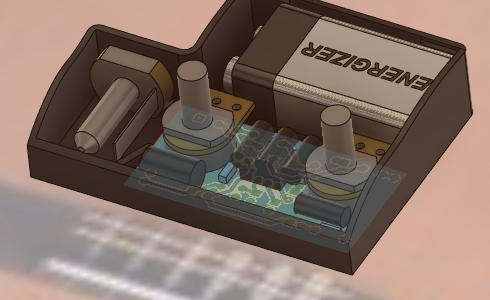
The battery was placed near the board and the female jack to the side as shown above. The jack was also trimmed with a Dremel to make it thinner.
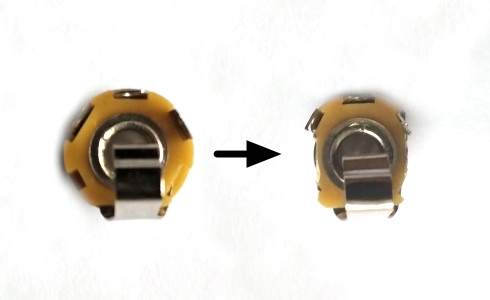
Female jack mod
There is no on/off switch in the design. In stead of using one, the female jack was modded so that the battery connects when a male jack is inserted.
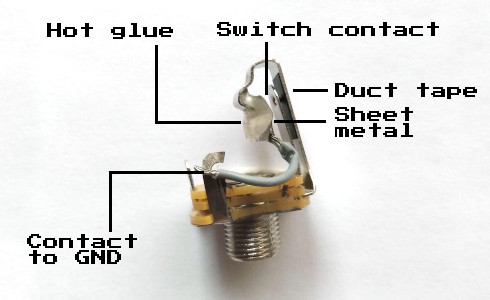
The original switched female jack's contact is blocked with duct tape. A new contact for the switch is placed on the opposite side. A piece of thin sheet metal is hot glued in place. When a male jack is inserted, the tip's contact is moved to the right and the switch closes, connecting the switch pin of the female jack to its ground connection. The battery's ground is connected to the switch pin so that when a male jack is inserted, the battery's ground connects with the board.
Circuit
This is how the complete circuit looks in the casing:
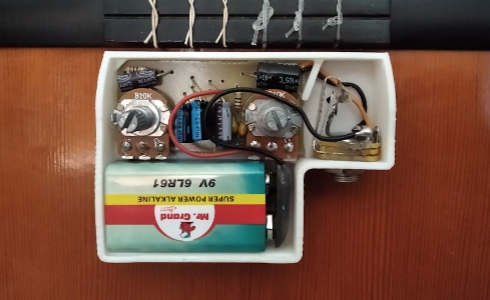
The piezoelectric element is fixed with a thin layer of white tag onto the wooden body of the guitar, right underneath the casing of the preamplifier. A hole is manually made on the bottom of the casing for the piezoelectric element's wiring. The preamplifier is placed on top with double sided tape.
Casing
The casing was designed to be easily 3D printed using a minimum amount of supports. The only geometry that needs supports to print correctly is the clip for the circuit board.
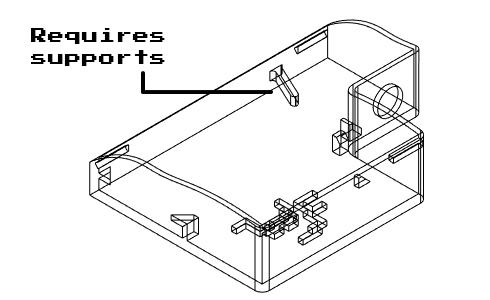
The bottom part of the case should be printed lying on its base while the top part(the cap) should be printed on its side with a brim for adhesion. The potentiometer knobs should be printed up side down.
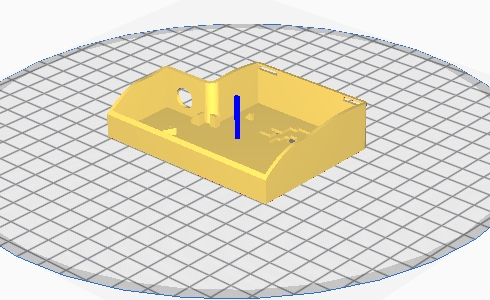
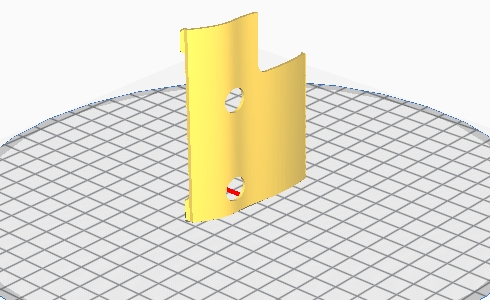
The STL files for the casing and the knobs for the potentiometers can be downloaded here.